RDMA: Difference between revisions
Jump to navigation
Jump to search
(Add categories: Linux, Reference) |
(Fix unclosed wikitable: close {|/|} + remove orphan Status; stops sections being swallowed into table) |
||
| (5 intermediate revisions by the same user not shown) | |||
| Line 1: | Line 1: | ||
RDMA | == Overview == | ||
RDMA에 대한 기술 문서입니다. | |||
=== Summary === | |||
* 무엇인가? - RDMA | |||
* 왜 필요한가? - HPC 및 서버 환경에서 필수 개념 | |||
* 언제 사용하는가? - 서버 구성, 성능 튜닝, 문제 해결 시 | |||
== Purpose == | |||
이 문서가 존재하는 이유 | |||
* Goal: RDMA에 대한 기술 정보 제공 | |||
* Scope: RDMA의 개념, 사용법, 설정 | |||
* Non-goals: 다른 주제로의 확장 | |||
== Key Concepts == | |||
{| class="wikitable" | |||
! Concept | |||
! Description | |||
! Related | |||
|- | |||
| RDMA | |||
| HPC/서버 환경에서 중요한 기술 개념 | |||
| [[Linux]], [[Server]] | |||
|} | |||
== | == Detailed Explanation == | ||
# Infiniband is a network protocol tailored specifically for RDMA, which can ensure the reliability of data transmission from the hardware level. Although InfiniBand technical specifications and standard specifications were officially published in 2000, InfiniBand Architecture (IBA) has been widely used on cluster supercomputers after 2005. The biggest reason for the slow development is that Infiniband requires its own dedicated hardware from L2 to L4. The cost of the enterprise is very high. | RDMA (Remote Direct Memory Access), which means remote direct memory access, is a network communication protocol that was first applied in the field of high-performance computing, and has gradually become popular in data centers. | ||
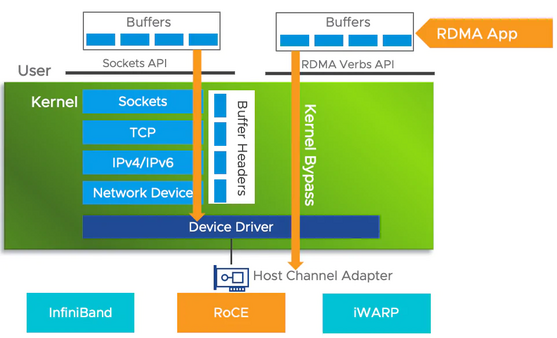
RDMA allows user programs to bypass the operating system [[kernel]] (CPU) and directly interact with the network card for network communication, thereby providing high bandwidth and extremely small latency.<ref>https://www.naddod.com/blog/rdma-high-speed-network-for-large-model-training</ref> | |||
[[File:RDMA FLOW.png|center|frameless|557x557px]] | |||
# Infiniband is a network protocol tailored specifically for RDMA, which can ensure the reliability of data transmission from the hardware level. Although [[InfiniBand]] technical specifications and standard specifications were officially published in 2000, InfiniBand Architecture (IBA) has been widely used on cluster supercomputers after 2005. The biggest reason for the slow development is that Infiniband requires its own dedicated hardware from L2 to L4. The cost of the enterprise is very high. | |||
# RoCE (RDMA over Converged Ethernet) is a protocol for implemtenting RDMA in an Ethernet network for a cheaper RDMA option. RoCE primarily provides RDMA capabilities over Ethernet. | # RoCE (RDMA over Converged Ethernet) is a protocol for implemtenting RDMA in an Ethernet network for a cheaper RDMA option. RoCE primarily provides RDMA capabilities over Ethernet. | ||
## RoCEv1, which runs at the link layer and cannot be run over a routed network. Therefore, it requires the priority flow control (PFC) to be enabled. The RoCE v1 protocol is an Ethernet link layer protocol allowing two hosts in the same Ethernet broadcast domain (VLAN) to communicate. It uses Ethertype 0x8915, which limits the frame length to 1500 bytes for a standard Ethernet frame and 9000 bytes for an Ethernet jumbo frame. | ## RoCEv1, which runs at the link layer and cannot be run over a routed network. Therefore, it requires the priority flow control (PFC) to be enabled. The RoCE v1 protocol is an Ethernet link layer protocol allowing two hosts in the same Ethernet broadcast domain (VLAN) to communicate. It uses Ethertype 0x8915, which limits the frame length to 1500 bytes for a standard Ethernet frame and 9000 bytes for an Ethernet jumbo frame. | ||
## RoCEv2, which runs over layer 3. Because it is a routed solution, consider using explicit congestion notification (ECN) with RoCEv2 as ECN bits are communicated end-to-end across a routed network. By changing the packet encapsulation to include IP and UDP headers, RoCE v2 can now be used across both L2 and L3 networks. This enables Layer 3 routing, which brings RDMA to network with multiple subnets for great scalability. Therefore, RoCE v2 is also regarded as Routable RoCE (RRoCE). Owing to the arrival of RoCE v2, the IP multicast is now also possible. | ## RoCEv2, which runs over layer 3. Because it is a routed solution, consider using explicit congestion notification (ECN) with RoCEv2 as ECN bits are communicated end-to-end across a routed network. By changing the packet encapsulation to include IP and UDP headers, RoCE v2 can now be used across both L2 and L3 networks. This enables Layer 3 routing, which brings RDMA to network with multiple subnets for great scalability. Therefore, RoCE v2 is also regarded as Routable RoCE (RRoCE). Owing to the arrival of RoCE v2, the IP multicast is now also possible. | ||
# iWARP iWARP is a protocol for implementing RDMA across Internet Protocol (IP) networks. Its advantage is that it can run in today's standard TCP/IP network. RDMA can be used only by purchasing a network card that supports iWARP. For those with a slightly lower financial budget It is especially suitable for enterprises. But its disadvantage is that it is slightly worse than RoCE in performance. After all, you get what you pay for. | # iWARP iWARP is a protocol for implementing RDMA across Internet Protocol (IP) networks. Its advantage is that it can run in today's standard TCP/IP network. RDMA can be used only by purchasing a network card that supports iWARP. For those with a slightly lower financial budget It is especially suitable for enterprises. But its disadvantage is that it is slightly worse than RoCE in performance. After all, you get what you pay for. | ||
{| class="wikitable" | {| class="wikitable" | ||
!Contents | !Contents | ||
| Line 28: | Line 51: | ||
|Wore than InfiniBand and RoCE | |Wore than InfiniBand and RoCE | ||
|Poor | |Poor | ||
|} | |||
== Best Practices == | |||
* 최신 버전 사용 권장 | |||
* 공식 문서 참고 | |||
* 테스트 환경에서 먼저 검증 | |||
== References == | |||
* [https://wiki.hpcmate.com RDMA] | |||
== Related Pages == | |||
* [[Linux]] | |||
* [[Server]] | |||
* [[Hardware]] | |||
* [[Network]] | |||
[[Category:Network]] | |||
== Knowledge Graph == | |||
Related | |||
→ [[Linux]] | |||
→ [[Server]] | |||
→ [[Hardware]] | |||
→ [[Network]] | |||
[[Category:Reference]] | |||
== RoCE vs InfiniBand 비교 == | |||
{| class="wikitable" | |||
! Feature ! RoCE v2 ! InfiniBand | |||
|- | |||
| 네트워크 | Ethernet | 전용 IB 네트워크 | |||
|- | |||
| 스위치 | 표준 Ethernet 스위치 | IB 스위치 | |||
|- | |- | ||
| | | 레이턴시 | 1-2 μs | 0.5-1 μs | ||
| | |- | ||
| | | 대역폭 | 100/200/400 GbE | 200/400 Gb/s | ||
| | |||
| | |||
|- | |- | ||
| | | 비용 | 낮음 (기존 인프라 활용) | 높음 | ||
| | |||
| | |||
|- | |- | ||
| | | 설정 복잡도 | 낮음 | 높음 | ||
| | |||
| | |||
|- | |- | ||
| | | ECN 지원 | 있음 | 있음 | ||
| | |||
| | |||
|- | |- | ||
| | | TSO/LRO | 지원 | 지원 | ||
| | |||
| | |||
|} | |} | ||
== | === RoCE 설정 === | ||
<syntaxhighlight lang="bash"> | |||
# RoCE v2 활성화 | |||
ethtool --set-ets eth0 pfc 1 0 0 0 0 1 0 0 | |||
# PFC (Priority Flow Control) 설정 | |||
ethtool --pause eth0 rx on tx on | |||
# RoCE 성능 테스트 | |||
ib_write_bw -d mlx5_0 -F | |||
</syntaxhighlight> | |||
== | === IB 설정 === | ||
<syntaxhighlight lang="bash"> | |||
# IB 링크 상태 확인 | |||
ibstatus | |||
# IB 성능 테스트 | |||
ib_write_bw -d mlx5_1 | |||
ib_send_lat -d mlx5_1 | |||
# OpenMPI 연동 | |||
mpirun --mca btl_openib_allow_rc 1 -np 8 ./app | |||
</syntaxhighlight> | |||
Latest revision as of 12:47, 12 October 2026
Overview
RDMA에 대한 기술 문서입니다.
Summary
- 무엇인가? - RDMA
- 왜 필요한가? - HPC 및 서버 환경에서 필수 개념
- 언제 사용하는가? - 서버 구성, 성능 튜닝, 문제 해결 시
Purpose
이 문서가 존재하는 이유
- Goal: RDMA에 대한 기술 정보 제공
- Scope: RDMA의 개념, 사용법, 설정
- Non-goals: 다른 주제로의 확장
Key Concepts
| Concept | Description | Related |
|---|---|---|
| RDMA | HPC/서버 환경에서 중요한 기술 개념 | Linux, Server |
Detailed Explanation
RDMA (Remote Direct Memory Access), which means remote direct memory access, is a network communication protocol that was first applied in the field of high-performance computing, and has gradually become popular in data centers. RDMA allows user programs to bypass the operating system kernel (CPU) and directly interact with the network card for network communication, thereby providing high bandwidth and extremely small latency.[1]

- Infiniband is a network protocol tailored specifically for RDMA, which can ensure the reliability of data transmission from the hardware level. Although InfiniBand technical specifications and standard specifications were officially published in 2000, InfiniBand Architecture (IBA) has been widely used on cluster supercomputers after 2005. The biggest reason for the slow development is that Infiniband requires its own dedicated hardware from L2 to L4. The cost of the enterprise is very high.
- RoCE (RDMA over Converged Ethernet) is a protocol for implemtenting RDMA in an Ethernet network for a cheaper RDMA option. RoCE primarily provides RDMA capabilities over Ethernet.
- RoCEv1, which runs at the link layer and cannot be run over a routed network. Therefore, it requires the priority flow control (PFC) to be enabled. The RoCE v1 protocol is an Ethernet link layer protocol allowing two hosts in the same Ethernet broadcast domain (VLAN) to communicate. It uses Ethertype 0x8915, which limits the frame length to 1500 bytes for a standard Ethernet frame and 9000 bytes for an Ethernet jumbo frame.
- RoCEv2, which runs over layer 3. Because it is a routed solution, consider using explicit congestion notification (ECN) with RoCEv2 as ECN bits are communicated end-to-end across a routed network. By changing the packet encapsulation to include IP and UDP headers, RoCE v2 can now be used across both L2 and L3 networks. This enables Layer 3 routing, which brings RDMA to network with multiple subnets for great scalability. Therefore, RoCE v2 is also regarded as Routable RoCE (RRoCE). Owing to the arrival of RoCE v2, the IP multicast is now also possible.
- iWARP iWARP is a protocol for implementing RDMA across Internet Protocol (IP) networks. Its advantage is that it can run in today's standard TCP/IP network. RDMA can be used only by purchasing a network card that supports iWARP. For those with a slightly lower financial budget It is especially suitable for enterprises. But its disadvantage is that it is slightly worse than RoCE in performance. After all, you get what you pay for.
| Contents | RoCE | Infiniband | iWARP | TCP/IP |
|---|---|---|---|---|
| High scalability | Good | Excellent | Wore than InfiniBand and RoCE | Poor |
Best Practices
- 최신 버전 사용 권장
- 공식 문서 참고
- 테스트 환경에서 먼저 검증
References
Related Pages
Knowledge Graph
Related
→ Linux → Server → Hardware → Network
RoCE vs InfiniBand 비교
| Feature ! RoCE v2 ! InfiniBand |
|---|
| Ethernet | 전용 IB 네트워크 |
| 표준 Ethernet 스위치 | IB 스위치 |
| 1-2 μs | 0.5-1 μs |
| 100/200/400 GbE | 200/400 Gb/s |
| 낮음 (기존 인프라 활용) | 높음 |
| 낮음 | 높음 |
| 있음 | 있음 |
| 지원 | 지원 |
RoCE 설정
# RoCE v2 활성화
ethtool --set-ets eth0 pfc 1 0 0 0 0 1 0 0

# PFC (Priority Flow Control) 설정
ethtool --pause eth0 rx on tx on

# RoCE 성능 테스트
ib_write_bw -d mlx5_0 -F
IB 설정
# IB 링크 상태 확인
ibstatus

# IB 성능 테스트
ib_write_bw -d mlx5_1
ib_send_lat -d mlx5_1

# OpenMPI 연동
mpirun --mca btl_openib_allow_rc 1 -np 8 ./app